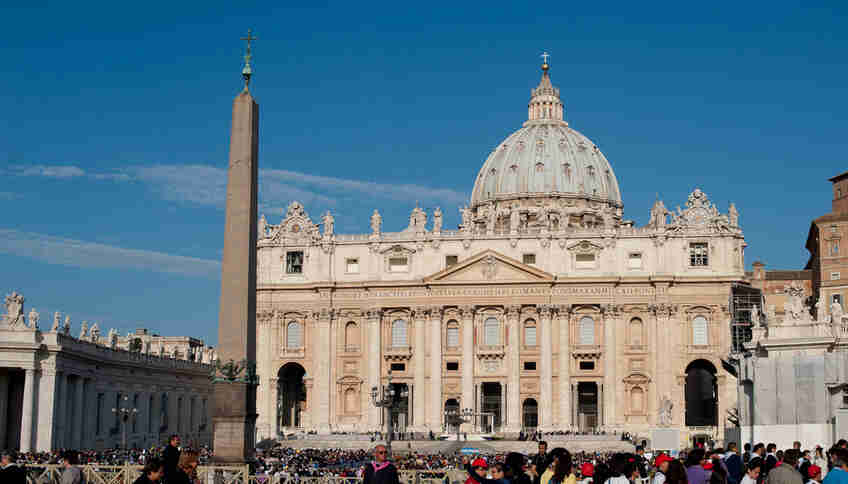

The world's main Catholic cathedral. Several generations of great masters worked on its creation: Bramante, Raphael, Michelangelo, Bernini...
St. Peter's Basilica is one of the largest churches in the world. The building has incredible dimensions and can hold 60000 people, which is, no less, the population of a small town such as Vyazma. The height of the Basilica is also astonishing - from the ground to the top of the cross it is 138 meters (to picture it, mentally stack five 9-story buildings on top of one another). The area of the structure is 22067 sq.m, which is comparable to three world-class football fields. Now that your imagination has fully run wild, it is time to move on to the story of how such a monumental structure was built, one that has now become one of Rome's main attractions.
Learn more about St. Peter's Basilica and the artifacts kept inside it by downloading our free mobile app - Travel Planner for iPhone and Android. Attractions, ready-made walking routes, an offline map, and GPS - everything you need for a trip to Rome.
The history of Basilica di San Pietro dates back to the VI century AD, when the first basilica was built on the site of the former circus of the Roman emperor Nero. It was erected over the tomb of St. Peter, who died in agony in that very circus in 66 AD. Then a second basilica was built on the same site, and it stood until the XV century, when it began to collapse from age. At that point, the decision was made to build a new church that would be larger than all the others.
The construction of St. Peter's Basilica stretched over several centuries. The best architects, sculptors, and painters of Europe were brought in to work on it, including Raphael and Michelangelo. By the way, Michelangelo was only 23 at the time. It was at that age that he created his first Pieta, "The Mourning of Christ." It can still be seen in the Basilica to the right of the entrance. After the tragic incident when a deranged geologist tried to smash the statue with a hammer, the Pieta was enclosed behind bulletproof glass.
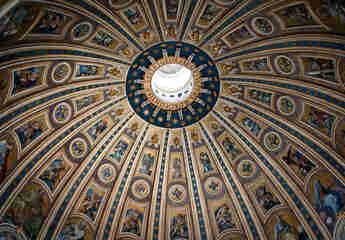
Upon entering St. Peter's Basilica, visitors involuntarily lift their heads upward, overwhelmed by the height and beauty of the dome. Its diameter is just over 41 meters. Few people know that 10 metal chains are installed between its shells, preventing the dome from collapsing.
On the floor you can see markers indicating the dimensions of the other great churches of the world. They show just how vast and grand St. Peter's Basilica is.
Special attention should be paid to the enormous bronze baldachin, through which the apse with the Chair of St. Peter can be seen. The light passing through the dome creates a beautiful glow, reminiscent of the constant presence of the Holy Spirit.
Thank you! Every time you book hotels on Booking.com through our website, you help us describe one more place, create one more route, or develop one more city. Thank you for that!
banner booking
Along the walls of the basilica there are many statues depicting outstanding Catholics of royal dynasties, as well as funerary monuments installed above the tombs of Popes. On a marble slab in the cathedral sacristy is carved a list of the names of all the pontiffs (beginning with the Apostle Peter) who are buried in this Basilica.
You can enter St. Peter's Basilica free of charge. But to climb to the roof and see Rome's attractions from a bird's-eye view, you will have to pay 7 euros. It is worth it. It is from the Basilica's observation deck that you can see the symbolic key to heaven, designed by the famous architect Lorenzo Bernini. Look down and in the semicircular colonnades of the square you will see the shape of a key.
Have wonderful travels!
Guides and routes around Rome:
- Guide to Rome
- First self-guided route through Rome: Vatican and the Vatican Museums
- Second self-guided route through Rome: Castel Sant'Angelo - Piazza Navona - Pantheon - Trevi Fountain
- Third self-guided route through Rome: Colosseum - Roman Forums - Piazza Venezia - Trajan's Column - Imperial Forums
- Fourth self-guided route through Rome: Trastevere district
- Night walk in Rome