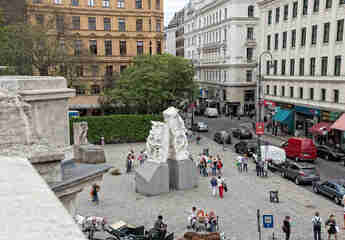
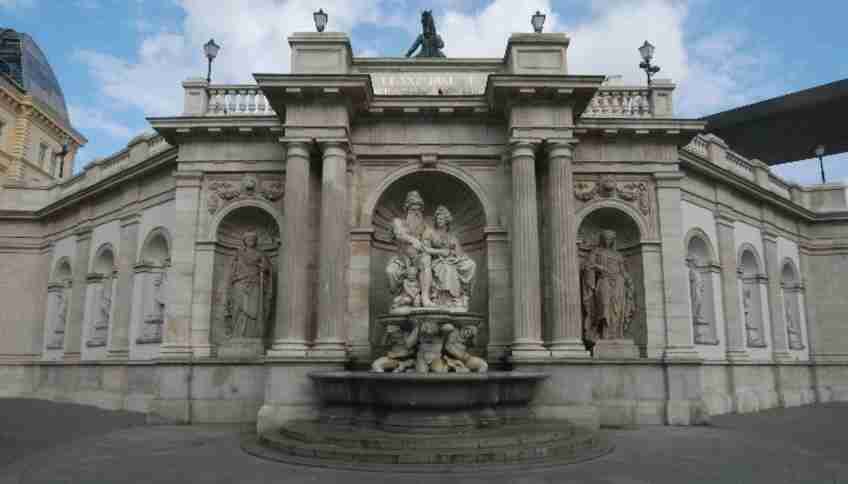
This fountain, executed in the Neo-Baroque style, was built in the second half of the 19th century. It was designed by Moritz von Lohr, and Johann Meixner worked on the sculptural composition.
In those days it was still customary to depict rivers in human form. This allegory helped convey the full power of the water element, which could not only be used for the benefit of people, but also become the cause of great destruction.
The Albrecht Fountain consists of several sculptures, the main ones being the Danube (or Danubius, as the river's name sounds in Latin) in the form of a sea lord and Windobona with a diadem on her head. Windobona is the old name of Vienna, remaining from the times when there was still a Celtic settlement on the site of the city. She holds the key to the city in her hands. This symbol was long used by sculptors so that even uneducated people who could not read could understand exactly what the statue personified. As we know, Vienna is not only the name of the city, but also of the river that flows through it.
Next to the Danube and Windobona there are several more sculptures, much smaller in size, - these are tributaries of the Danube. This river has 10 tributaries in total, but now in the niches next to the fountain we can see only 8 sculptures. The reason is that during the Second World War the fountain was heavily damaged by bombing. It was only partially restored, but two sculptures were lost forever, and their niches were bricked up.
You may be surprised why Danubius is depicted as so formidable. The reason is that the creator of this fountain wanted to emphasize that the Danube flooded cities more than once; its turbulent waters destroyed buildings and ruined the crops of local residents. But at the same time, with his left hand the Danube embraces Vienna, which signifies his patronage and protection for the city.