About Milan
The capital of Lombardy is an incredibly vibrant city that has truly succeeded in embracing the impossible. Different eras intersect on its streets: the austere Middle Ages, the inspired Renaissance, the grandiose Classicism, and the utilitarian present day. A wealth of architectural and artistic landmarks packed into a relatively small area earns Milan the status of an open-air museum – yet that barely scratches the surface. Italy's football capital, Europe's opera capital, the world capital of fashion and shopping – these are all unofficial titles held by Milan.
A Brief History
The first settlement on the site of modern Milan was founded by the Celts around 600 BC. In 222 BC the ancient Romans conquered the city and named it Mediolanum. Over time, thanks to its strategically advantageous location, it even began to rival Rome for the title of capital of the empire.
After the fall of the Roman Empire, Milan was sacked by the Huns and the Ostrogoths, then seized by the Lombards. Gradually all power became concentrated in the hands of the Archbishop of Milan: until the end of the 8th century, the clergy only expanded and consolidated their influence. Yet as trade grew and citizens prospered, opposition to the Church's unlimited authority swelled. In 1045 the city declared its independence.
Milan's rising power displeased Frederick Barbarossa, who in 1162 besieged, captured, and razed the city. Nevertheless, through the efforts of the Lombard League it was rebuilt just five years later.
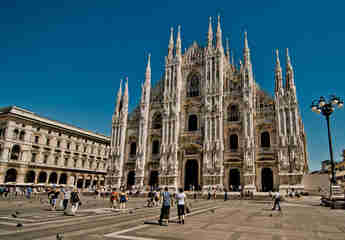
From the early 13th century, having gained a number of economic privileges, Milan grew ever more powerful. Ruling dynasties came and went, but the city flourished and cemented its status as a cultural capital of Europe. In 1386 construction began on the monumental Duomo cathedral, which remains Milan's chief symbol to this day.
By the mid-15th century the city had become one of the world's first industrial centres, particularly in textile manufacturing and silk production.
Between the 15th and 17th centuries the Duchy of Milan passed back and forth between the Spanish and the French, leading to economic and cultural stagnation. In 1630 a devastating plague struck the city.
In the early 18th century control passed to Austria, but in 1859 the people of Lombardy, led by the Milanese, overthrew foreign rule. In 1861 the independent Kingdom of Italy was proclaimed, and Milan was expected to become its capital. For various reasons that never happened, yet the city went on to become the country's most important economic, industrial, and cultural centre.
Good to Know:
– 1 January – New Year's Day
– 6 January – Epiphany
– March/April – Easter Monday
– 25 April – Liberation Day
– 1 May – International Workers' Day
– 2 June – Republic Day
– 15 August – Assumption of Mary (Ferragosto)
– 1 November – All Saints' Day
– 7 December – Feast of Saint Ambrose, patron saint of Milan. City Day.
– 8 December – Immaculate Conception
– 25 December – Christmas
– 26 December – St Stephen's Day
The second half of February and the second half of September – Milan Fashion Week.
An Independent Trip to Milan
Getting from the Airport to the City Centre
Malpensa Airport (Aeroporto di Milano-Malpensa), the largest in the Lombardy region, is 45 km from the city centre. You can reach Milan by:
Public Transport in Milan
A single unified ticket covers all forms of public transport in Milan. The simplest single-ride ticket costs 2 euros. A 24-hour pass is 7 euros; a 48-hour pass – 14. For 3 euros you can buy an evening ticket valid from 8:00 pm until the last service, and for 18 euros – a carnet of 4 rides of up to 90 minutes each.
Milan's metro is one of the longest in Italy. It has 4 lines and runs from 6:00 am to midnight. An extensive network of surface routes covers the entire city. Buses and trams run from 5:00 am to 2:00 am, while trolleybuses operate around the clock. There are also 14 night bus routes serving the most popular destinations, running from 12:30 am to 4:30 am (until 6:00 am on weekends).
Worth a special mention is the Radiobus – night minibuses that cruise the city without a fixed route. You call them in advance using the numbers posted at stops. The fare is double that of a regular bus, but you get an almost taxi-like ride – straight to your destination.
Bike Rental in Milan – BikeMi
Milan's bike-sharing system operates around the clock and has over 200 stations across the city. First you need to register – either online or at a kiosk at the Duomo, Cadorna, Loreto, Romolo, Centrale FS, or Garibaldi FS stations. A one-day pass costs 4.50 euros; a weekly pass – 9 euros.
You can pick up the white-and-orange bikes at any dock and return them wherever you like – the same station or any other. The first 30 minutes are free; after that it is 2 euros per hour.
Mobile Service and Internet in Italy
The most popular providers are TIM, Wind, and Vodafone. A SIM card costs roughly 15–30 euros, most of which goes onto your balance. Plans are fairly similar, with special offers for tourists. By law you must present your passport when purchasing. Free Wi-Fi is not ubiquitous – expect to find it mainly in hotels, cafes, and restaurants.
Shopping in Milan
Milan is known as the fashion capital of the world, and many people come here specifically to shop. The shopping scene is indeed superb: every major fashion brand has a store here stocking a vast range of the season’s latest pieces – and at prices well below what you would pay in many other European capitals.
That said, do not expect bargain-basement deals: the high-street scene is no better here than anywhere else, and the premium segment will not come cheap even during the seasonal sales, which run every January–February and July–August. However, 60–100 km outside the city you will find outlet villages selling past-season collections at 50–70% off year-round.
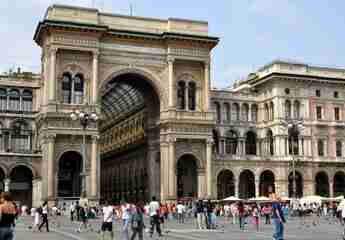
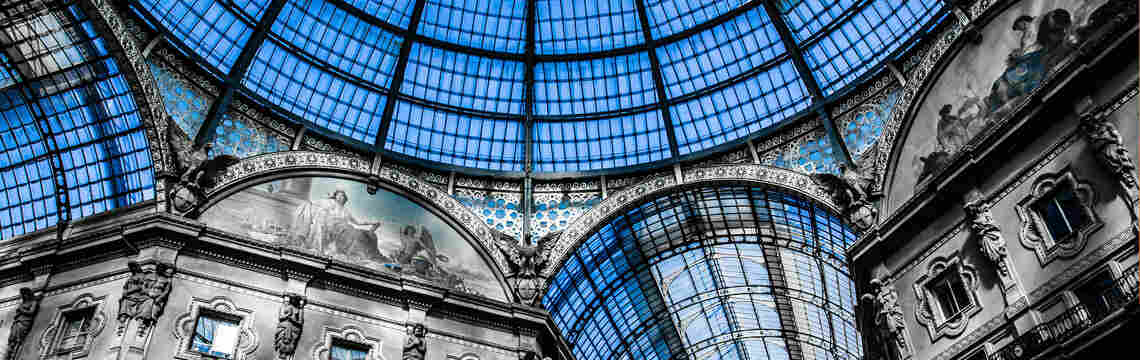
The shopaholic’s mecca is the Galleria Vittorio Emanuele II, which adjoins the Piazza del Duomo. For most visitors it is more of a landmark than a shopping destination, but if you are looking for a red-carpet gown, this is the place to go.
The ”Fashion Quadrilateral”, home to the lavish boutiques of the top fashion houses, is formed by Via Montenapoleone, Via Sant’Andrea, Via Monzani, and Via Della Spiga. Via Marghera is the go-to street for shoes. Mid-range stores line Via Vittorio Emanuele and Corso Buenos Aires, while up-and-coming local designers and affordable youth labels cluster along Corso di Porta Ticinese. For casual style, head to Via Torino; for elegant classics – Corso Vercelli.
Typical shop hours are 9:30 am to 1:00 pm and 3:30 pm to 7:30 pm, with Sundays and Monday mornings off. Large department stores and Fashion Quadrilateral boutiques stay open seven days a week with no midday break. Before Christmas nearly every shop stays open round the clock, while in August many close for a two-week holiday.
Local Cuisine
The most famous dishes of Milanese cuisine are saffron risotto (Risotto allo Zafferano) and the Milanese veal cutlet (Cotoletta alla Milanese). Also well worth trying are ossobuco (Ossobuco) – a cut of meat on the marrow bone slow-braised with vegetables for 3–4 hours – and cassoeula (Cassoeula) – a fragrant stew of cabbage, sausage, and pork.
A seasonal treat is the Christmas cake panettone (Panettone), studded with raisins and candied fruit. Two cheeses are considered quintessentially Milanese – mascarpone and gorgonzola. A great souvenir to bring home is Milano salami, regarded as one of Italy's finest cured meats.
In cafes and restaurants it is customary to leave a 5–10% tip; in a bar, a little loose change on the counter. In taxis the fare is usually rounded up. Hotel housekeeping staff also appreciate a small gratuity.
See Also: