A Trip to Madrid
Spain’s capital is rightly considered one of the most beautiful cities in the world. It is a pleasure to wander its winding streets, admiring churches from different eras, Baroque buildings and fine examples of Art Nouveau architecture. In Madrid’s famous museums you can see world masterpieces with your own eyes, then settle into a small family restaurant and slowly enjoy a hearty traditional lunch.
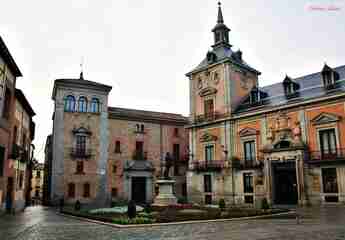
Yet Madrid is not an open-air museum, but a modern metropolis where big-city life buzzes against a backdrop of grand palaces and medieval squares. Great shopping, picturesque parks and nightclubs famous all over Europe add variety to the cultural program, while the warmth and friendliness of the locals bring vivid color to the trip.
A Little History
The first settlements in the area around Madrid appeared about 100,000 years ago, although the city itself arose much later. It is believed to have been founded by Muhammad I, Emir of Córdoba, as a defensive stronghold. The first mention of the fortress of Majrit dates back to 932.
In 1085, during the Reconquista, Madrid was conquered by the Spanish king Alfonso VI. Over the next 500 years, the city’s development was shaped above all by relations between Spaniards and Arabs, who alternated between fragile truces and renewed war.
In 1561, Madrid became the capital of the Spanish kingdom and began to grow rapidly. By the end of the 16th century its population had reached 50,000 people, and during the reign of Charles V of Habsburg it doubled.
At the beginning of the 18th century, the Spanish crown passed to the Bourbon dynasty. Under Charles III, the city became a true European capital. Leading architects of the era worked on Madrid’s appearance. The water system was modernized, the streets were paved and street lighting was installed.
Development stalled in 1808, when the French seized the city. The popular uprising was brutally crushed – an episode that inspired one of Francisco Goya’s most famous paintings. The war of liberation soon grew into the Spanish Revolution.
After the restoration of the monarchy, Madrid’s development resumed. In the late 19th and early 20th centuries, the city had to be substantially rebuilt: broad, straight boulevards replaced the narrow old streets. Art Nouveau took over from Neoclassical architecture.
During the Civil War of 1936–39, fierce fighting raged for Madrid, damaging many historic landmarks and greatly worsening the city’s economic situation. Only in the 1950s did conditions stabilize and the economy and tourism begin to recover gradually. In the late 1970s came the “movida” – a vibrant boom in subcultures and many forms of art.
On March 11, 2004, Madrid suffered a tragedy comparable to the events of September 11, 2001 in the United States: bombs exploded simultaneously at several railway stations across the city. In memory of the victims, the “Forest of the Departed” memorial was built.
Important to know:
– January 1 – New Year’s Day
– January 6 – Epiphany
– Good Friday and Easter
– May 1 – Labour Day
– May 2 – Community of Madrid Day
– August 15 – Assumption of the Virgin Mary
– September 12 – National Day of Spain (Hispanidad Day)
– November 1 – All Saints’ Day
– December 6 – Spanish Constitution Day
– December 8 – Feast of the Immaculate Conception
– December 25 – Christmas Day.
Planning an Independent Trip to Madrid
How to Get from Madrid Airport to the City
Madrid-Barajas Airport (Aeropuerto de Madrid-Barajas), the largest airport in the country, is located 12 km from the capital. You can reach the city:
Getting Around Madrid
Madrid’s public transport system is considered one of the best in the world. It is built around the metro and buses, complemented by light rail, commuter trains, funiculars, bicycles and scooters.
The Madrid Metro – the second largest in Europe – covers the entire city. Its radial-and-ring network consists of 13 lines. The stations are attractively designed, and clear signage makes the complex system of passageways easy to navigate. Exits are marked with the word “Salida.” The metro runs from 6:00 to 01:30.
Bus routes also cover the entire city and, on top of that, operate around the clock. To board a bus, you need to hail it at the stop; to get off, warn the driver in advance by pressing one of the special buttons inside.
The same tickets are valid on both forms of transport. You can buy them at metro ticket offices and machines, from bus drivers, and at newspaper and tobacco kiosks. A single ride costs 1.1 euros, while a 10-trip Metrobus pass costs 11.20 euros.
The light metro (metro ligero) has three lines and is essentially a fast tram system. The routes run mainly through central districts. A ride costs 2.4 euros.
Taxis in Madrid are white with a red stripe on the front doors. The meter starts at 1.3 euros per kilometer, plus the initial flag-drop charge of 2–4 euros depending on the time of day and day of the week.
Tourist Cards in Madrid
Mobile Connection and Internet in Spain
Madrid has many places with free internet access: not only cafés and restaurants, but also libraries, squares, dedicated Wi-Fi kiosks and even buses.
The most popular mobile operator in Madrid is considered to be Movistar. For 10 euros, you can buy a SIM card with 75 minutes of calls and 1 GB of data. Orange offers a special tourist tariff called “SIM-holidays”: calls to Russian mobile numbers cost 8 cents per minute, and every 10 MB of data costs 30 cents.
Shopping in Madrid
Madrid is a wonderful city for shopping. Of course there are modern shopping centers here, but you will get far more pleasure from wandering through the many traditional little shops and boutiques. Most of them are family businesses that have kept the same specialty for decades – some sell souvenirs, others antiques, others gorgeous fabrics, and so on. Pastry shops and sweet stores occupy a special place: their signature recipes are kept secret and passed down only within the family.
Most shops are open from 8:00 to 20:00, with a siesta break from 14:00 to 17:00, although large shopping centers usually stay open through lunch. Youth clothing stores are concentrated in the Arguelles district. The shopping centers along Gran Via carry popular European brands. Everything most prestigious and expensive is gathered in the Salamanca district: antique and jewelry salons, premium clothing and shoe stores, and exclusive accessories.
The Cuatro Caminos district is home to shops from Spanish makers of clothing, shoes and jewelry, as well as many cafés and restaurants. Extravagant designer clothing and accessories can be found in the bohemian neighborhoods of Chueca and Fuencarral.
Shops around Puerta del Sol in the very center of the city are extremely popular with tourists – there is a huge choice of souvenirs here, as well as several branches of the famous department-store chain El Corte Ingles. The El Rastro flea market takes place on Sundays from 9:00 to 15:00 along Ribera de Curtidores.
Local Cuisine
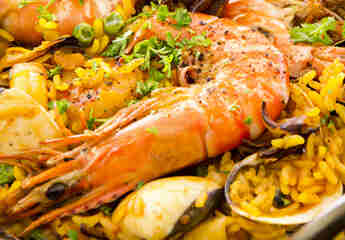
Madrid cuisine is rich in delicious soups: from chilled gazpacho made with fresh tomatoes to hot cocido – a thick pea soup with vegetables, meat and cured meats that is cooked in a special pot.
Lunch is almost unthinkable without meat: practically everything edible is used, from ears to tail. The signature dish is callos – tripe stewed with blood sausage, vegetables and spices. If you want an alternative to meat, cod prepared in many different ways is a good choice.
In Madrid’s cafés and restaurants, it is customary to leave a tip of around 10% of the bill. People also usually leave a small tip (about 1 euro) for taxi drivers and hotel maids.
Read also: