Museum Island

Flickr, Jonny_BKirchhain
Museum Island (German: Museumsinsel) is the name given to the northern tip of Spree Island on the River Spree in Berlin, where an entire constellation of famous Berlin museums is located. Museum Island is a magnet for tourists and art lovers from all over the world. Since 1999, this unique architectural and cultural ensemble has been inscribed on the UNESCO World Heritage List.
In the Middle Ages, the northern part of Spree Island consisted of marshy flood meadows. In the southern, higher part of the island, the city of Cölln arose as early as the 13th century, and its northern part later became the garden of the Berlin City Palace. In the 17th century, the left arm of the Spree was equipped with a system of canals. The present-day Kupfergraben canal came into being, thanks to which the northern part of the island was drained. Between the Spree and the Kupfergraben, Cölln Island took shape, where Lustgarten was laid out in the second half of the 17th century.
Berlin Cathedral

Flickr, bob bobsson
Berlin Cathedral (German: Berliner Dom) is the largest Protestant church in Germany (part of the EKD). It is located on Berlin's Museum Island.
Berlin Cathedral has never been a cathedral in the strict sense of the term, because Berlin, let alone this church, has never been the seat of a bishop of the Catholic Church. When the Holy See first created a Catholic diocese in Berlin in 1930, Berlin Cathedral had long since been a Protestant church. St. Hedwig's Cathedral serves as the seat of the Metropolitan Archbishop of Berlin. The bishop's duties include regular Protestant sermons at St. Mary's Church, which serves as the bishop's residence. The Kaiser Wilhelm Memorial Church is his second seat.
If you like this route, when you finish reading it, click the “Add to trip” button below. To do this, you will need to sign up or log in through a social media account. It only takes a minute and will help you easily plan your trip to Berlin.
Lustgarten Park

Flickr, Paul 'Tuna' Turner
Lustgarten (German: Lustgarten — pleasure garden) is a park on Museum Island in central Berlin, not far from the former City Palace, of which it was originally a part. At various times in its history, the park was used for parades, mass demonstrations, and as a public park. The Lustgarten area was originally laid out in the 16th century as the palace kitchen garden of what would become the residence of the Elector of Brandenburg and later the center of the Prussian kingdom. After Germany was devastated during the Thirty Years' War, Berlin was rebuilt by Frederick William (the Great Elector) and his Dutch wife Louise Henriette of Orange. In 1646, Electress Louise, with the help of military engineer Johann Moritz and gardener-decorator Michael Hanff, transformed the former vegetable garden into a formal park with fountains and geometrically aligned paths and gave it its present name.
Old Museum

Flickr, EuropanetzwerkDeutsch
Old Museum (German: Altes Museum) is a museum in Berlin on Museum Island. Until 1845, it was called the Royal Museum (German: Königliches Museum). The museum building was erected in 1822—1830 by architect Karl Friedrich Schinkel in the Neoclassical style to house the art collection of the family of the Prussian kings. After restoration in 1966, the museum houses a collection of classical antiquities. The Stoa in Athens was chosen as the model for the museum building. The Ionic order adorns the columns of the main facade, while the other three facades are built of brick and stone. The building rises above the surrounding area on a plinth, which gives it an imposing appearance. The elevation helped protect the museum building from the floods that occurred on the island. The course of the River Spree, which washes Museum Island, was altered by the architect to create more space during the construction of the museum, and the necessary reconstruction of roads, bridges, and canals was carried out.
You can find dozens more interesting sights of Berlin on the interactive map, which is especially convenient because you can spread the places across several days of your trip and then sync them with your smartphone.
New Museum

Panoramio, Filip Tesarčík
New Museum (German: Neues Museum) is a museum in Berlin, located on Museum Island and recognized as a UNESCO World Heritage Site. The museum building, constructed in 1843—1855 in the late Neoclassical style, is considered the main work of Karl Schinkel's student Friedrich August Stüler and a renowned example of 19th-century museum architecture. The need to build a second museum on Museum Island arose because of the lack of space in the Old Museum. The New Museum was intended to house the collections of plaster casts, the Egyptian Museum, the Museum of National Antiquities, the ethnographic collection, and the print room. Construction work began on June 19, 1841 under the supervision of a commission appointed by Frederick William IV. The commission included, in particular, Ignaz von Olfers, director general of the Royal Museums of Berlin, and Friedrich August Stüler.
Old National Gallery

Flickr, Robert Scarth
Old National Gallery (German: Alte Nationalgalerie) is a gallery on Museum Island in Berlin. The gallery houses 19th-century works from the collection of the Prussian Cultural Heritage Foundation. The gallery was founded in 1861 on the basis of a collection of 262 paintings donated by banker Johann Heinrich Wagener. Initially, the collection was housed in the buildings of the Academy of Arts. The current building in the form of a Roman temple with an apse was designed in 1865 by Friedrich August Stüler based on a sketch by King Frederick William IV and built in 1869—1876 under the direction of Heinrich Strack. During World War II, the building suffered significant damage as a result of air strikes. The gallery partially resumed its work in 1949, and reconstruction continued until 1969.
Download the Ever.Travel mobile app for free! This route is presented there in the form of a convenient guide, available even offline.
Pergamon Museum

Panoramio, Bach Quatre
Pergamon Museum (also Pergamonmuseum, German: Pergamonmuseum) is one of the most famous museums located on Museum Island on the River Spree in the center of Berlin. The museum building was constructed in 1910—1930 to a design by Alfred Messel and Ludwig Hoffmann, primarily for the Pergamon Altar discovered by Carl Humann, as well as for the collection of Late Antiquity painting and sculpture, the exhibits of the Museum of the Ancient Near East, including works of Hittite, Assyrian, Babylonian, and Persian art, and the Museum of Islamic Art (including the Mshatta facade). Since 1958, all these collections have been united under the general name “Pergamon Museum.” At present, the museum's exhibition is divided into the Collection of Classical Antiquities, the Museum of the Ancient Near East, and the Museum of Islamic Art. In 2005, about 960 thousand visitors came to the Pergamon Museum, and it is the most visited museum in Berlin.
Bode Museum

Flickr, Jonny_BKirchhain
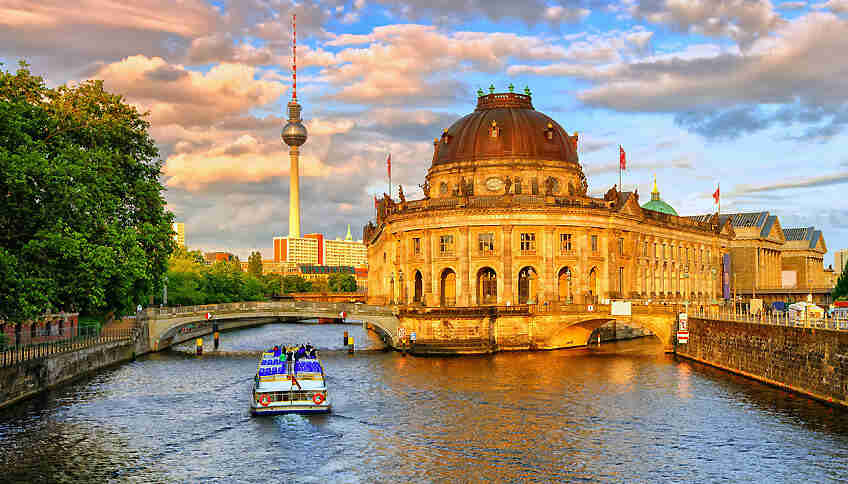
Bode Museum (German: Bode-Museum) is an art museum within the Museum Island ensemble in Berlin, housing the displays of the Sculpture Collection, the Museum of Byzantine Art, and the Numismatic Collection. On October 17, 2006, the museum reopened after a six-year restoration.
The idea of creating a museum of art in Berlin arose in 1871 at the imperial court among the entourage of the crown prince and later German emperor Frederick III. Specific proposals were presented by Wilhelm von Bode. Court architect Ernst von Ihne erected the museum building between 1897 and 1904 for Bode's sculpture and painting collection, whose foundation had been laid by the cabinets of curiosities of the Electors of Brandenburg. The museum opened on October 18, 1904, on the birthday of Frederick III, who died in 1888. The Neo-Baroque building is located at the northeastern tip of Museum Island on a plot measuring 6 000 m² and shaped like an irregular triangle.
See also other walking routes in Berlin:
- Self-guided tour of central Berlin
- Alexanderplatz in Berlin
- Route for lovers of modern architecture
- A day off in Berlin
- “Berlin — a city of contrasts”: a tour with elements of extreme adventure