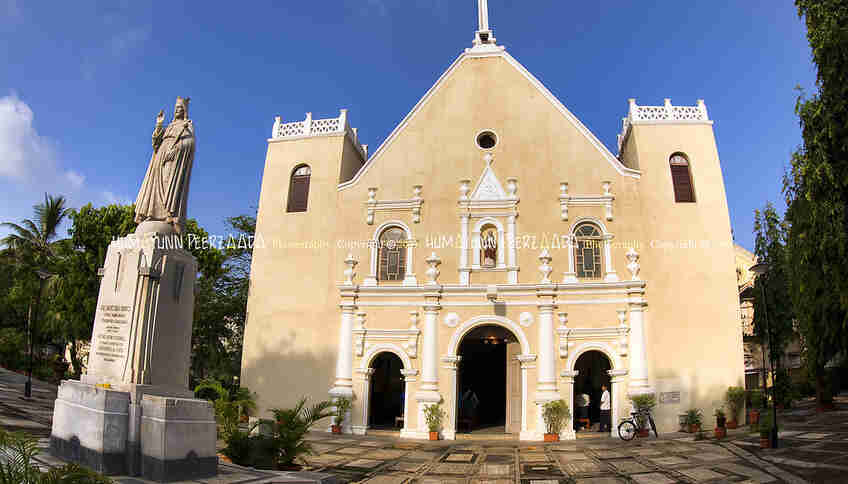
The Roman Catholic St. Andrew's Church in Mumbai was built during the period of Portuguese rule in India. Portuguese Jesuits had been trying to convert the residents of the Bandra area to Christianity since 1568, but their efforts were not particularly successful.
Even the construction of the incredibly beautiful and, by the standards of that time, large St. Andrew's Church in 1575 did not attract Hindus to the new faith. The situation changed when the monk Manuel Gomes arrived at the Catholic mission; he spoke the local dialect and knew the customs of the Hindus. Thanks to his work, by 1580 the church already had more than 2000 parishioners, and by 1603 almost the entire Bandra area had become Catholic.
The building of St. Andrew's Church is quite restrained on the outside: the only decorations are stucco around the windows and a tall Gothic gable with a cross, flanked by square towers. But do not let its outward modesty deceive you - there is plenty to see inside.
The main altar, adorned with statues of the Sacred Heart of Jesus, the Virgin Mary, and Saint Andrew, reaches the roof of the building and is a fine example of religious art. The side altars are carved from wood, as is the antique pulpit for sermons, and date to approximately the 16th century. The carvings on the altars depict scenes of the Assumption of the Virgin Mary and the Resurrection of Christ.