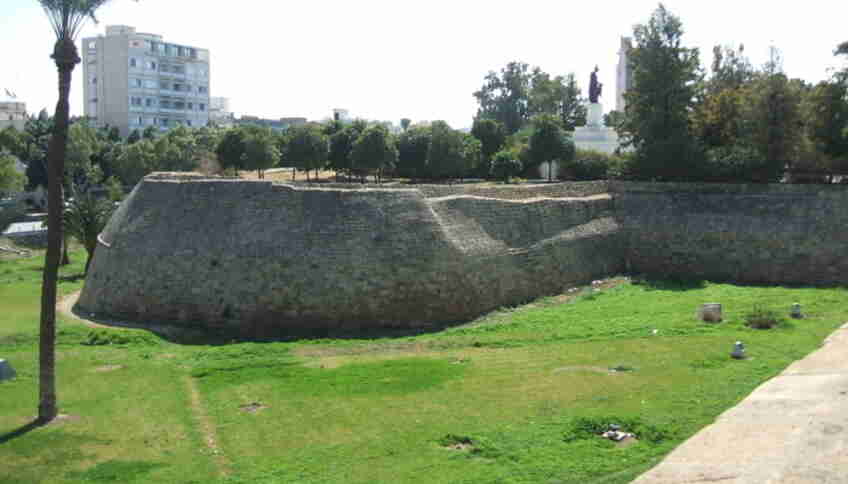
The Venetian Walls form a massive stone enclosure that once protected the ancient city of Nicosia. It is hard to call it a ring, because from above it looks more like an 11-pointed star.
Each of the 11 “corners” is a bastion built in the shape of a regular pentagon. They were given names in honor of famous aristocratic families that provided funds for the construction of the fortification.
The walls are earthen ramparts faced with cobblestones. They are called Venetian because the main stage of their construction began in 1567, when the city was conquered by the Venetians. The fortification was built around the old city; outside there was only a moat, and beyond that a dense forest.
It was possible to get inside the fortress only through the gates, of which there were three: Kyrenia, Famagusta, and Paphos. The Famagusta Gate has survived best to this day. In the last century, the number of such “passages” increased noticeably after roadways for cars were made through the walls. In some places, the walls were even widened with embankments for roads.
The total length of the walls is 5 km. Half of them extend into the northern occupied part of the capital. During the Turkish conquest, the Constanza Bastion was the first to fall, and the Bayraktar Mosque is now located there.