Museum of Hetmanship

Panoramio, Ivan Bykov / Ivan Bykov
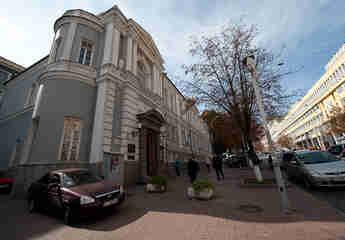
Hetman of the Zaporozhian Host (Ukr. Hetman Viiska Zaporozkoho, Polish Hetman wojsk kozackich) was originally the leader of the lower Cossacks, and later the ruler of the Hetmanate. In the Polish-Lithuanian Commonwealth, the title of hetman was used for the highest-ranking officers of the armies of the Kingdom of Poland and the Grand Duchy of Lithuania (see Hetmans of the Polish-Lithuanian Commonwealth). In official state terminology with regard to the registered Cossacks, the concept of Senior of the Zaporozhian Host[1] was more often used, and the term hetman began to be used regularly starting with Bohdan Khmelnytsky, who was called “Hetman of His Royal Grace's Zaporozhian Host”[2]. After the conclusion of the Pereiaslav Treaty, the hetman of the registered Cossacks came to be called “Hetman of His Tsarist Most Serene Majesty's Zaporozhian Host”[3]. In the Grand Duchy of Lithuania, as well as in the Kingdom of Poland, there were state offices of hetmans: the grand hetmans (respectively crown and Lithuanian) were ministers of defense in the respective parts of the Commonwealth.
National Museum “Chernobyl”

Flickr, Jorge Lascar
National Museum “Chernobyl” (Ukr. Natsionalnyi muzei “Chornobyl”) is a museum in Kyiv dedicated to the Chernobyl disaster. The museum opened on 26 April 1992 in the building of the Podil fire station (in the 1980s this and the neighboring building housed the Kyiv regional fire department, which took the main blow in fighting the fire at the Chernobyl Nuclear Power Plant). The exhibition includes about 7,000 exhibits — declassified documents, maps, photographs, and monuments of Polissia folk architecture collected by museum expeditions in the Chernobyl exclusion zone. Here you can see unique video materials about the disaster and its consequences, using the three-phase diorama “Chernobyl Nuclear Power Plant before, during, and after the accident” and a working model of a CNPP power unit, which expand the museum's chronological and thematic scope and enhance the authenticity of the exhibition. Next to the museum stands the sculptural composition “Hope for the Future”.
Peter I House

mapia.ua
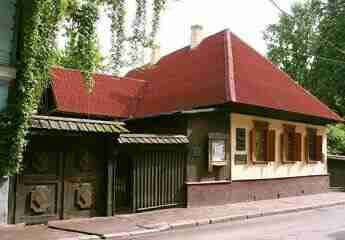
“Peter I House” in Kyiv is the name[1] of an architectural monument from the turn of the XVII−XVIII centuries in Kyiv, located in Podil at 6/8 Kostiantynivska Street (at the intersection with Khoryva Street). Today it functions as a branch of the Museum of the History of Kyiv — the Museum of the History of Charity in Kyiv. According to some sources, Tsar Peter I stayed in this house during his visit to Kyiv in 1706. There is an opinion that the building belonged to Hetman Ivan Mazepa, who personally hosted the tsar.[1]. However, Ukrainian historians, for example, Fyodor Ernst (ukr.)rus., do not recognize the fact that Peter I stayed in this house. The story of Peter I having been here is often called an urban legend. On 29 June 1909, as part of the celebration program for the 200th anniversary of the Battle of Poltava, the authorities solemnly unveiled a marble[2]memorial plaque in honor of Peter I on the building. In 1965 this plaque was replaced with a new granite one, with a graphic image of the emperor.
One Street Museum

cutoutandkeep.net
One Street Museum is dedicated to the history of Andriivskyi Descent, one of the oldest streets in Kyiv, which connected the Upper Town with the Lower Town — Podil. The museum's concept is based on the desire of its creators to bring the history of Andriivskyi Descent and Kyiv as close as possible to the individual, without a pompous presentation of historical processes, without national, religious, cultural, or political bias. “The material world of the museum conventionally divides the exhibition into two parts — the world of women and the world of men. The world of women is characterized by care for the internal arrangement of the home, the creation of coziness and comfort. The artistic and figurative solution of the first hall introduces visitors to the world of the houses of Andriivskyi Descent. The world of men is directed outward — travel, craft, commerce, wars and wanderings, the eternal companions of any people. These images are given preference in the second hall. Thus, the modern philosophy of postmodernism permeates every corner and every display case of this museum.”[1]
Mikhail Bulgakov Museum

livejournal.com, senat-perm
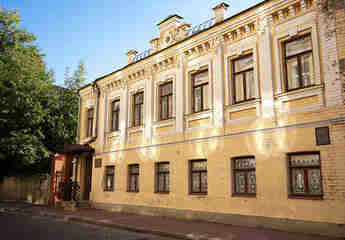
The Turbin House — the literary-memorial house-museum of Mikhail Afanasyevich Bulgakov — was founded at the beginning of 1989. The main exhibition is located on the second floor of the house. Here you can see Bulgakov's personal belongings and hear the story of his life in Kyiv. This story is closely intertwined with his novel “The White Guard”. The name Turbin House became attached to the house thanks to the writer Viktor Nekrasov, after his essay “Turbin House” was published in the magazine “Novy Mir” (1967, No. 8). The house is called not by the surname of the author of the novel “The White Guard”, but by the surname of the heroes who “lived” here. The building was built in 1888—1889 according to the design of architect N. N. Gardenin for the wife of the merchant Litoshenko. The Bulgakovs lived in this “amazingly built” house for 13 years from 1906 to 1919. The mansion consists of a stone basement and first floor, and the entire upper floor is wooden, lined with brick and covered with iron. The new owner of the house became Z. P.
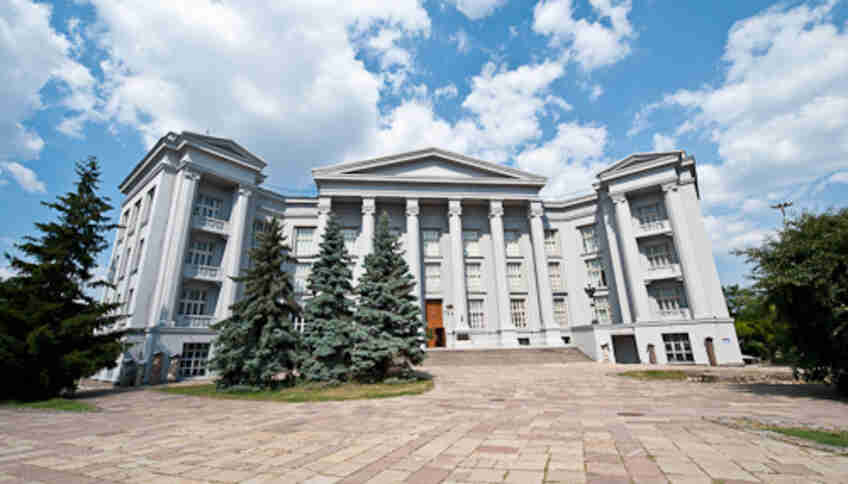
National Museum of the History of Ukraine
mapia.ua
National Museum of the History of Ukraine is the leading historical museum of Ukraine. Since 1944 it has been located in Kyiv, on Starokyivska Hill. The Museum of the History of Ukraine houses ethnographic and archaeological collections, works of painting and sculpture, numismatic collections, early printed books, and other historical exhibits. The museum building, which received the status of an architectural monument, was built in 1937—1939 according to the design of architect I. Yu. Karakis and was originally intended for the first art school in the entire Ukrainian Republic. Art historians of a modern guidebook to Kyiv described the building as follows: Others add: In front of the building, the architect designed an interestingly shaped staircase with lamp posts. Near the building, later, on the observation platform, a stone was installed with the words of Nestor the Chronicler carved on it in Old Slavonic: “from here the Rus land began to be”.

archunion.com.ua
Taras Shevchenko House-Museum is one of the three museums in Kyiv dedicated to the famous Ukrainian writer. It is housed in a building that was constructed in 1835 and is, in essence, a rare example of urban development from that time. Back then this place was called Kozye Boloto, and collegiate secretary Ivan Zhytnytskyi lived in the house; it was he who gave Shevchenko the recommendation that enabled him to enter the Academy of Arts.
Over time the building became dilapidated, and after the revolution it was given over to domestic use, but in 1925, at the request of the artist Vasyl Krychevsky, who was a professor at the Institute of Architecture, the Zhytnytskyi house was repaired. Krychevsky also took charge of the work on designing the house-museum, the rooms, the garden, and the workshop.
On 10 November 1928, the Zhytnytskyi house was finally opened to visitors. Here they recreated the atmosphere of 1846-1847 — it was during this time that Taras Shevchenko lived in Kyiv before his arrest in the case of the Cyril and Methodius Brotherhood.

Panaramio, SergeyUA
The Taras Shevchenko Museum, located on the boulevard named after the Ukrainian poet and artist, opened its doors to visitors in 1949. At that time its exhibits reflected facts from the extensive biography of Taras Shevchenko, but during the museum's existence the exhibition space has been repeatedly renewed and significantly restructured.
For example, one of the large-scale renovations was carried out in the second half of the 80s of the last century: then it was decided to combine the collections of the Central State Shevchenko Museum in Kyiv and the Kharkiv gallery, where the artist's paintings were kept. At the same time, quotations from classics of the Soviet period were removed from the exhibition.
Now the National Museum of Taras Shevchenko holds about 4000 exhibits connected in one way or another with the personality of the great Ukrainian poet and artist: paintings, easels, pencils, pens, and, of course, books.
National Museum of Arts named after Bohdan and Varvara Khanenko

nr2.ru
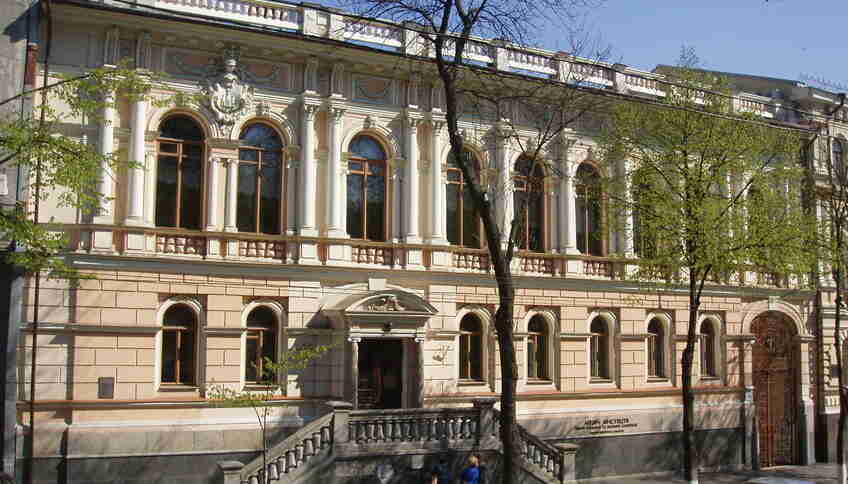
National Museum of Arts named after Bohdan and Varvara Khanenko (former name — Kyiv Museum of Western and Eastern Art) is an art museum in Kyiv, the foremost collection of foreign art objects in Ukraine. The presence of extremely valuable and unique art monuments in the museum's collection brought the museum fame far beyond the borders of Ukraine. In the museum's storerooms and picture gallery are kept the private collection of the Khanenko family (1.25 thousand exhibits), the collection assembled by scientist-chemist V.A. Shchavinsky, exhibits received through inter-museum exchange, and acquisitions from other sources. At present, the museum's collection numbers over 25 thousand exhibits. Bohdan Ivanovych Khanenko graduated from Moscow University and received an appointment in St. Petersburg (1871). There he became acquainted with Yu. V. Druzhinin, the brother of the famous writer, and D. V. Grigorovich, secretary of the St. Petersburg Society for the Encouragement of Artists. In St. Petersburg, Khanenko became interested in collecting.
PinchukArtCentre

news.uklon.com.ua
PinchukArtCentre is a center of contemporary art located in Kyiv. Founded on 16 September 2006 as part of the activities of the Victor Pinchuk Foundation. PinchukArtCentre is an international center of contemporary art of the XXI century, an open platform for artists, art, and society. PinchukArtCentre is located in the old architectural ensemble of Kyiv's Bessarabsky Quarter, which was restored at the beginning of the ХХІ century. The architectural project and interior design of the art center were developed by French architect Philippe Chiambaretta. The center occupies 6 floors and combines exhibition halls on 4 floors, a video-lounge hall and a cafe on the 6th floor, as well as an administrative section. The total area of the art center is more than 3000 sq.m. Since its opening, the art center has become one of the favorite places of Ukrainian youth, Kyiv residents, as well as the capital's numerous tourists.